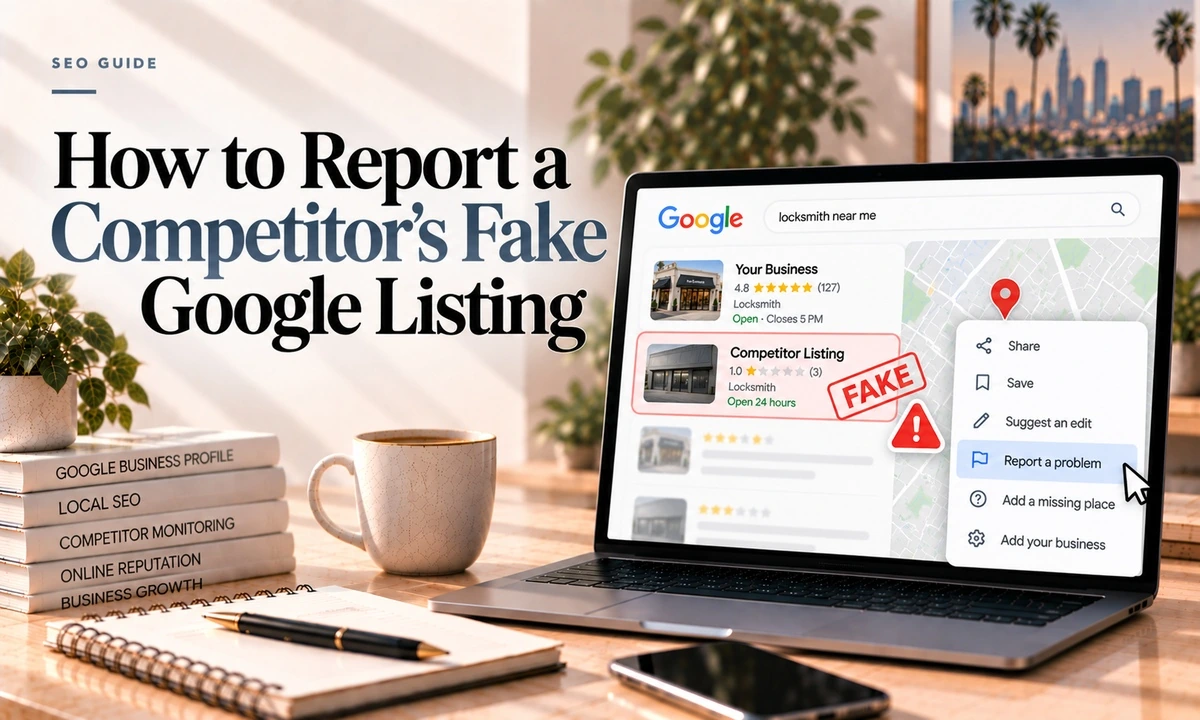
You do everything right. Real address, real signage, real reviews collected one at a time. And you are sitting at position seven while three listings above you are a keyword string at an address that turns out to be a storage unit.
This is not something you have to accept. There is a real process, it works often enough to be worth the half hour, and almost nobody uses it properly.
First, Check It Is Actually Spam
Before you report anything, confirm the listing breaks a written rule. "They rank above me" is not a rule. These are:
- Keywords in the business name. Google's name rules bar marketing taglines, store codes, trademark symbols, fully capitalised words, business hours, phone numbers and URLs. "Burbank Emergency Plumber 24/7" is a violation unless that is genuinely the registered business name on the signage.
- An address that is not a real place of business. PO boxes and remote mailboxes are not acceptable. Virtual offices are not eligible. A coworking address only qualifies with clear signage, customers received during business hours, and your own staff present.
- Duplicate listings. Google's rule is one profile per location, in a single account or across multiple accounts.
- A business that does not exist. Lead generation operations build these at random addresses to capture calls and sell them on.
A report with evidence gets a different outcome to a report that just says "this is fake." Before you file, gather: a Street View screenshot of the address showing no such business, the Secretary of State or state licence registry showing no entity by that name, a photo if it is local enough to drive past, and what happens when you call the number. Spending twenty minutes on this is the difference between a report that works and one that disappears.
Route One: Suggest an Edit
On the listing in Google Maps, tap the business, scroll to Suggest an edit, and either correct the detail or report that the place is closed or does not exist.
Be realistic about what this achieves. On an unclaimed listing it often publishes quickly and it is the fastest fix available. On a claimed listing it goes to the owner for approval, who will reject it, and even if it goes through, a spammer simply restores the keyword-stuffed name from their dashboard. Suggest an edit has become noticeably less effective over the years for exactly this reason.
There is an irony worth knowing. In April 2026 Google started proactively emailing verified owners about suggested edits so they can review changes before they go live. That is a genuinely good protection for real businesses. It also means the spammer gets a notification and a reject button.
Route Two: The Business Redressal Complaint Form
This is the real tool, and it still exists under that exact name. It is Google's dedicated channel for malicious content on listings, and it is what you use for keyword-stuffed names on claimed listings, fake addresses, and businesses that do not exist.
What it asks for:
- Your name and contact email
- The name of the impacted business, meaning yours
- The type of malicious content: title, address, phone number, website, or that the business does not exist
- The public Maps URL of the offending listing
- A free text explanation
Two things the form tells you itself, and they set expectations correctly: Google cannot guarantee any action will be taken, and you will not be updated on the status. If you have several listings to report, the form recommends submitting 10 to 100 at a time for faster processing.
In the explanation field, quote the exact offending text, name the specific guideline it breaks, and say what harm it causes a searcher. "The business name contains the keyword string Emergency Plumber 24/7, which violates the name guidelines prohibiting taglines and hours. The address is a UPS Store mailbox, confirmed by Street View." That reads like a case. "This is spam" does not.
How Long and How Often It Works
Honestly, nobody knows the success rate. No credible published figure exists for the redressal form, and any article quoting you a percentage is making it up or selling you a service. Timelines are disputed too: one practitioner estimate is around two weeks, another says well over a month.
What we do have is Google's own enforcement reporting, which gives a sense of scale:
| Google removed or blocked | 2024 | 2025 |
|---|---|---|
| Fake Business Profiles | 12 million plus | 13 million plus |
| Policy-violating reviews | 240 million plus | 292 million plus |
| Policy-violating edits | 70 million plus | 79 million |
| Accounts given posting restrictions | 900,000 plus | 782,000 |
And removal rates vary wildly by industry. A multi-year study of over 5,000 listings across 16 industries found roughly 88 percent of reported garage door repair listings removed, around 76 percent of personal injury lawyer listings, but only about 42 percent of locksmiths and 28 percent of handyman listings. That data runs 2022 to 2024, so treat it as a rough picture rather than today's odds.
Two Mistakes Worth Avoiding
- Reporting a competitor's duplicate can help them. If Google merges the duplicate rather than removing it, the merge combines review counts and they come out stronger. Think about which outcome you are likely to get before you file.
- Do not flood the form. In September 2026 Google added a misuse of support channels policy. Repeated unfounded submissions can result in all further complaints being rejected without assessment. Your credibility with that form is a resource you can spend.
If It Does Not Work
Two escalation routes exist. The Google Business Profile Help Community, where product experts monitor posts, and the independent Local Search Forum where the people who do this professionally hang out. Reports also tend to land better from an established account than a brand new one.
And the honest caveat: spam comes back. The same listings get cleaned up and reappear, sometimes within months. Treat it as maintenance, not a one-time fix. Check your top keywords quarterly.
Worth Knowing: Regulators Have Started Caring
This is no longer purely a Google problem. In March 2025 Google sued an alleged fake listing network after uncovering more than 10,000 fake listings concentrated in categories like locksmiths and towing. And in May 2026 the FTC and the State of Illinois took action against a company alleged to have created thousands of fake home repair business profiles since 2018, using fabricated company names at addresses belonging to unrelated parties, with fabricated five star reviews written by employees and relatives to dilute genuine one star reviews, and local phone numbers routed overseas. That case is pending, so those are allegations rather than findings.
The practical takeaway for an honest business is simply that the ground is shifting in your favour, slowly.
The Part That Matters More
Reporting spam removes competitors. It does not make you rank. If the listings above you are legitimate businesses doing the work better, the answer is the actual local SEO work, not the complaint form. Report what is genuinely fake, then go earn the position.
Frequently Asked Questions
How do I report a fake Google business listing?
There are two routes. For a single obvious problem, use Suggest an edit inside Google Maps on the listing itself. For keyword-stuffed names, fake addresses and businesses that do not exist, use the Business Redressal Complaint Form, which is Google's dedicated channel for malicious listing content. The form takes the Maps URL of the offending listing plus your explanation, and it recommends submitting 10 to 100 URLs at a time if you have several.
Does Suggest an edit actually work?
It works much better on unclaimed listings than claimed ones. On a claimed listing your edit goes to the owner for approval and is frequently rejected, and spammers simply restore the keyword-stuffed name from their dashboard. Google now emails verified owners about suggested edits, which helps legitimate businesses but also means a spammer gets notified and can reject you.
How long does a redressal complaint take?
Sources disagree. One practitioner estimate is around two weeks, another says well over a month. Google's form itself says it cannot guarantee any action will be taken and that you will not be updated on the status, so expect no reply either way and check the listing yourself after a few weeks.
What counts as a violation worth reporting?
Keyword stuffing in the business name, marketing taglines, phone numbers or URLs in the name, PO boxes and virtual offices used as addresses, coworking addresses with no signage or staff, duplicate listings for one location, and businesses that simply do not exist at the pin. A competitor who is legitimately ranking above you is not a violation.
Is reporting spam ever a bad idea?
Sometimes, yes. Reporting a competitor's duplicate listing can backfire if Google merges it rather than removing it, because the merge combines their review counts and leaves them stronger than before. And as of September 2026 Google has a misuse of support channels policy under which repeated unfounded submissions can get all your future complaints rejected without assessment. Report real violations with evidence, not everything that annoys you.
How much fake listing spam is there?
Google reported removing more than 13 million fake Business Profiles in 2025, up from more than 12 million in 2024, alongside 292 million policy-violating reviews and 79 million policy-violating edits. Removal rates vary enormously by industry. One multi-year study found roughly 88 percent of garage door repair listings reported for guideline violations were removed, against roughly 28 percent for handyman listings.
If you want a second opinion on whether the listings beating you are reportable or just better, send me your top three keywords and I will look. Processes here are current as of October 2026 and Google changes them regularly.