Note before anything else: I am not a lawyer, and the legal section below is general information, not legal advice. If you are considering legal action over a review, talk to an attorney.
A fake review is one of the few things that can hurt a small business overnight. The good news is that Google removed over 292 million policy-violating reviews in 2025. The bad news is that getting a specific one removed depends entirely on whether you can point to the policy it breaks.
The Only Question That Matters
Not "is this unfair." Not "is this untrue." The question is which written policy does this break. Google will not remove a review for being negative, and it will not remove a review because you disagree with it.
These are the categories that actually get reviews pulled:
| Category | What it covers |
|---|---|
| Fake engagement | Content not based on a real experience, reviews paid for directly or in kind, content posted from multiple accounts by or at the request of one person |
| Conflict of interest | Current or former employment, contractual relationships, industry competitors, family members |
| Off-topic | Content not based on an experience at that location |
| Harassment | Personal attacks on staff rather than a service account |
| Personal information | Names, addresses, phone numbers of individuals |
| Restricted content | Regulated goods, obscenity, sexually explicit material |
For most small businesses the two that do the work are conflict of interest and fake engagement. A competitor review, an ex-employee review, a review from someone's brother, a review from an account that has left nine identical reviews this week. Those are reportable, and naming the right category when you report dramatically improves your odds.
Click the reviewer's name. You can see every other review they have left. Pattern-hunt: have they reviewed three of your direct competitors glowingly and you once at one star? Do they have no other reviews at all and an account created last week? Have they left reviews in four cities on the same day? Screenshot it. That profile history is the single strongest piece of evidence you can bring, and almost nobody checks it.
The Process
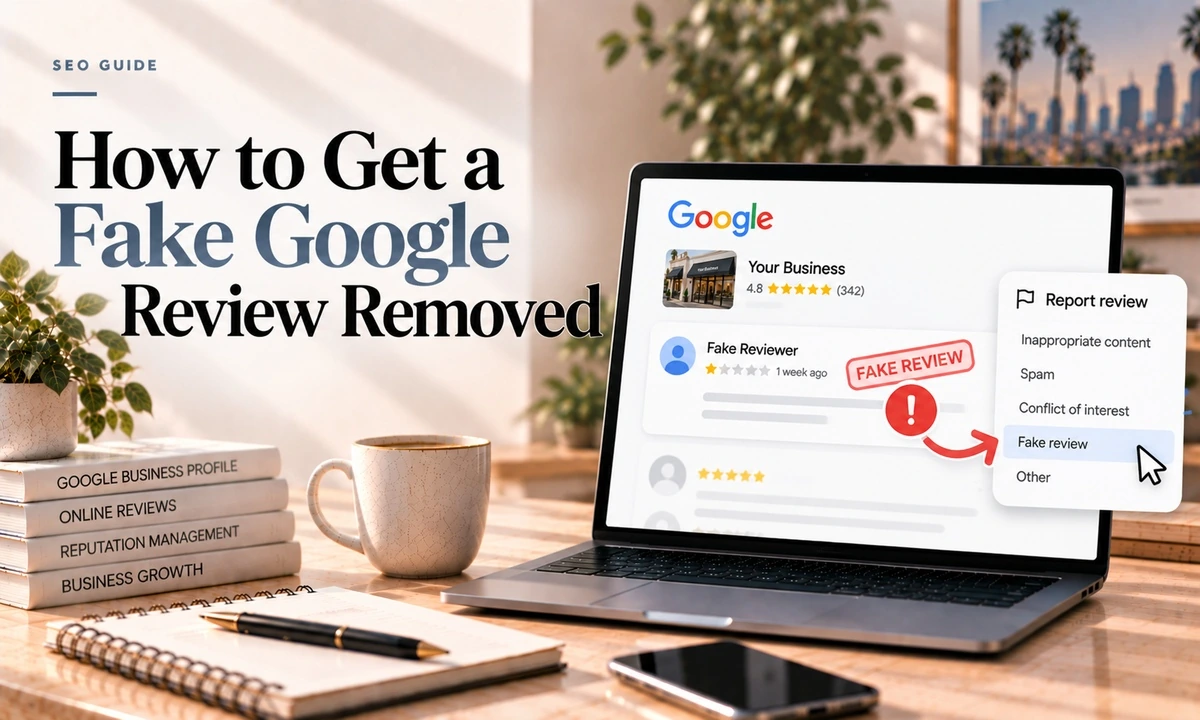
- Flag it in your profile. Go to your Business Profile, open Read reviews, click the Report icon next to the review and pick the violation reason. Google says review evaluation typically takes several days.
- Or use the Reviews Management Tool. This is the better route because it tracks status. Select the business, choose to report a new review for removal, pick the violation reason and submit.
- Check the status. You will see states like decision pending, or report reviewed with no policy violation found.
- Appeal once if denied. In the same tool, choose the option to check the status of reviews you reported and see appeal options. You can select up to ten reviews marked appeal eligible and submit with added context. Google emails the final decision.
- Escalate. If the appeal fails and you genuinely believe the review breaks policy, post in the Google Business Profile Help Community with your case ID. Product experts monitor it.
Respond to It Anyway
While you wait, and especially if removal fails, reply. Not for the reviewer. For the next twenty people who read it. A calm, specific, non-defensive reply that says you have no record of this person as a customer and invite them to contact you directly does more for your reputation than the review does against it. More on handling negative reviews here.
Never argue. Never share customer details in a reply. Never accuse someone publicly of being a competitor unless you can prove it.
If You Are Being Extorted
This is now its own category. If someone is threatening you with one-star reviews unless you pay, Google launched a dedicated reporting form for review extortion in November 2025. It asks for screenshots of the demands, links to the reviews, identifiers for the bad actor and a timeline. As of April 2026 Google also pauses reviews and shows consumer warnings on profiles hit by this kind of attack.
Do not pay. Document everything and report it.
The Legal Route, Carefully
Again: I am not a lawyer. This is general information about how the landscape works, and anything you actually do should go through an attorney.
Three things a California business owner should understand before spending money on this.
- Google is not the defendant. Section 230 shields platforms from liability for what users post. In Hassell v. Bird the California Supreme Court reversed an order directing Yelp to remove reviews. That said, the decision was fractured rather than a clean majority, and the controlling concurrence pointed the other way, so this area is less settled than it is usually described.
- Opinion is generally not actionable. California defamation requires falsity, among other elements. Most star ratings and subjective complaints about service are protected opinion. The limitation period is one year.
- Anti-SLAPP is the real risk. California's statute lets a defendant move to strike a claim arising from protected speech, and a prevailing defendant is entitled to recover their attorney's fees and costs. Whether a given review qualifies as a matter of public interest is case-dependent rather than automatic, but the exposure is real: a failed suit against a reviewer can mean paying their lawyer.
There is also a trap on your side. The FTC's consumer reviews rule prohibits review suppression through false accusations, physical threats, intimidation or unfounded legal threats. A bluffing cease and desist letter over a review you know is truthful is itself potentially a violation.
And Do Not Solve It By Breaking the Rules
The temptation after a bad review is to go collect ten good ones fast. Fine. Just not these ways.
- No incentives. Google prohibits offering payment, discounts or free goods in exchange for posting a review or for revising or removing a negative one.
- No gating. Google's policy explicitly prohibits discouraging negative reviews or selectively soliciting positive ones. The survey-first funnel that routes happy customers to Google and unhappy ones to a private form is against policy.
- No staff quotas. Google prohibits requesting that staff solicit a certain number of reviews, or reviews containing specific content.
- No contract clauses. California Civil Code section 1670.8 prohibits consumer contracts that waive the right to make statements about the seller, with civil penalties up to 2,500 dollars for a first violation and more for willful ones. The federal Consumer Review Fairness Act voids such terms too.
The FTC has started enforcing. In December 2025 it sent warning letters to ten companies over incentivised reviews, and a case settled in July 2026 with a four million dollar judgment, 750,000 dollars of it payable, over reviews written by employees posing as customers.
The Honest Summary
If the review breaks a written policy, report it properly with evidence and you have a real chance. If it is a genuine customer who had a bad day, you cannot remove it and you should not try. Reply well and bury it with real reviews collected the right way.
And a number worth holding onto: in a 2026 consumer survey, 97 percent of respondents thought businesses should be punished for fake reviews. Your customers are more suspicious of a perfect five star profile than you think.
Frequently Asked Questions
Can I get a bad Google review removed?
Only if it violates a Google content policy. A truthful but unflattering review will not be removed no matter how much it hurts, and Google is explicit that it does not remove reviews simply for being negative. What does qualify is fake engagement, conflict of interest such as a competitor or former employee, off-topic content, harassment, personal information, and restricted or dangerous content.
How do I report a review?
Open your Business Profile, go to Read reviews, click the Report icon next to the review and select a violation reason. For more control, use the Reviews Management Tool, which lets you report a review for removal and check the status of previous reports. If a report is denied you can appeal once, selecting up to ten reviews marked appeal eligible.
How long does review removal take?
Google says review evaluation typically takes several days. Reported experience is often around three business days for the initial decision, with appeals coming back by email within a few days. Nobody publishes a reliable success rate, and any vendor quoting you one is selling a service.
Can I get a one-star review with no text removed?
Usually not. A rating with no words is very hard to remove because there is no content to assess against a policy. It is frustrating and there is no good answer beyond burying it with genuine reviews.
Can I sue someone over a Google review?
You can, and in California you should think very hard first. I am not a lawyer and this is not legal advice. California's anti-SLAPP statute allows a defendant to move to strike a claim arising from protected speech, and a prevailing defendant is entitled to recover their attorney's fees and costs. Opinions are generally not actionable, the limitation period for defamation in California is one year, and unmasking an anonymous reviewer requires a prima facie showing of a valid claim first. Talk to an actual lawyer.
Can I offer a discount to get a bad review taken down?
No. Google's policy prohibits offering incentives in exchange for posting a review or for the revision or removal of a negative one. Separately, the FTC's consumer reviews rule prohibits review suppression through false accusations, threats, intimidation or unfounded legal threats, so a bluffing cease and desist over a truthful review is itself potentially a violation.
Send me the review and I will tell you straight whether it is reportable or whether you are better off replying well and moving on. To repeat the important part: I am not an attorney, nothing here is legal advice, and if you are weighing legal action you need a lawyer, not a web designer.