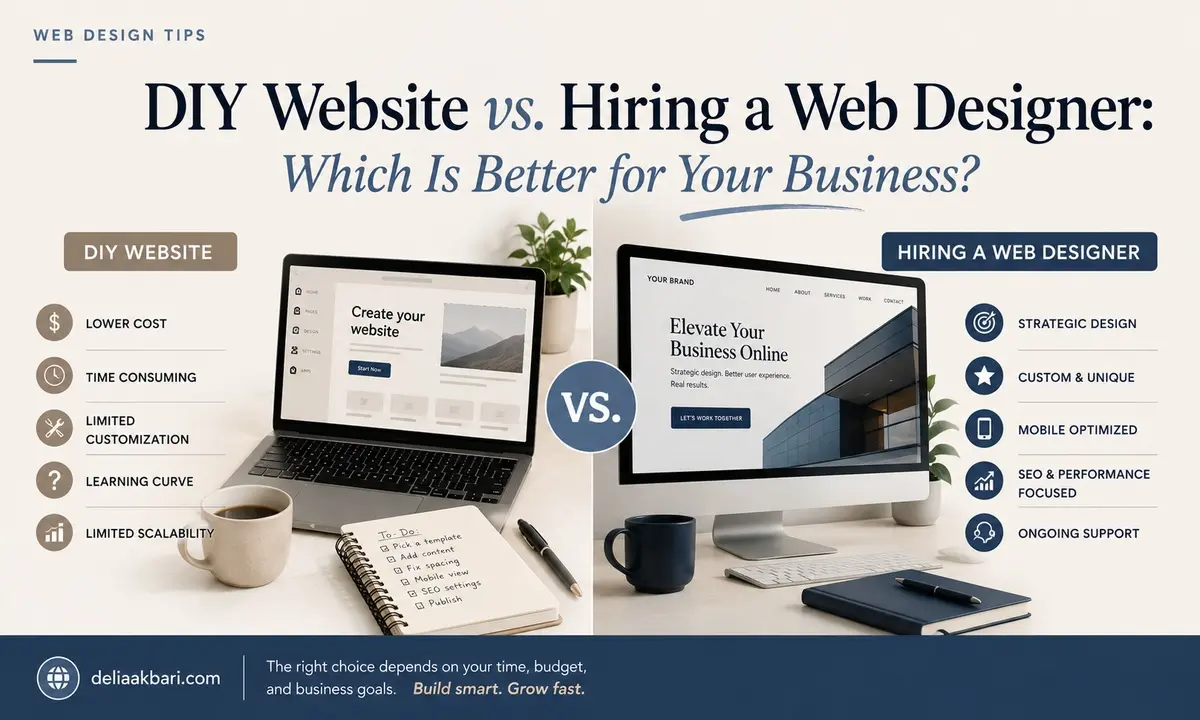
Every small business owner hits this decision eventually: build it yourself on Wix, Squarespace, or GoDaddy, or pay someone to build it for you. The DIY route is marketed as fast, cheap, and easy, and for some businesses it genuinely is the right call. For others, it quietly costs more in wasted hours and missed customers than hiring a designer would have upfront. The honest answer depends on what you're using the site for, so here's how to tell which side of that line you're on.
When DIY Actually Makes Sense
There are real situations where a website builder is the smarter choice, not just the cheaper one.
- You're testing an idea, not running a business yet. If you're validating whether an idea has any traction before investing real money, a quick builder site is a reasonable placeholder.
- You genuinely enjoy the tech side. Some business owners like tinkering with design and don't mind the learning curve. If that's you and you have the hours to spare, DIY can work.
- The site is a simple digital business card. A single page with your hours, address, and phone number, and nothing riding on it for lead generation, doesn't need a custom build.
- The budget genuinely isn't there yet. A $16-a-month builder is better than no website at all while you're saving up for something better.
Where DIY Falls Short for Most Small Businesses
Past that starting point, the same builder that felt easy on day one starts working against you.
- Every builder site tends to look like a builder site. Templates are built to be filled in by thousands of businesses, which means yours ends up looking like a dozen others in your area using the same theme.
- SEO is limited by the platform, not just your effort. Builders handle the basics, but they cap how much you can actually optimize page speed, code structure, and technical SEO, the stuff that determines whether you show up in search at all.
- It takes far longer than the ads promise. "Build a site in an hour" turns into evenings and weekends over several weeks once you're picking fonts, writing copy, and troubleshooting layout on your own.
- There's no strategy behind the design. A builder gives you blocks to arrange. It doesn't tell you why visitors are leaving without calling, or where your site should be steering them. That's a business decision, not a template setting.
- You're on the hook for it forever. Every future update, every broken layout after a plugin change, every "why isn't this showing up on Google" question is yours to solve alone.
The sticker price on a builder is never the real cost. If it takes you 20 hours to build a site that still doesn't convert visitors into calls, that's 20 hours away from actually running your business, plus every customer that site failed to bring in while it sat there half-finished. Time and missed leads don't show up on the monthly invoice, but they're the most expensive part of DIY for a business that depends on its website to generate work.
What You Actually Get With a Web Designer
Hiring a designer isn't just paying someone else to do the same thing faster. It changes what the site is capable of.
- A design built around your business, not a template. Layout, structure, and content built around how your specific customers actually make a decision to call or buy.
- SEO built in from the first line of code. Clean code, fast load times, and proper on-page structure that a drag-and-drop builder can't fully replicate.
- A site that's actually finished. No half-built pages, no "I'll get to that later" sections still sitting empty six months in.
- Your time back. Weeks of evenings you'd otherwise spend fighting with a template go back into running your business.
- Someone to call when something breaks. Post-launch support and an optional care plan instead of troubleshooting a broken plugin alone at 11pm.
Three Questions to Decide Which Fits You
- Does this site need to bring in customers, or is it just informational? If it's doing real lead-generation work, the gap between DIY and custom shows up fast in results.
- What's your time actually worth right now? If 15 to 20 hours of your time costs more than the price difference between a builder and a designer, DIY isn't actually the cheaper option.
- Can you keep it updated, secure, and working long-term? A site that gets built once and never maintained tends to fall behind fast, on design, on speed, and on search rankings.
What Hiring a Designer Actually Costs
This is usually the part that talks people out of even asking. Working with an independent designer instead of a big agency keeps it more affordable than most people expect: flat-rate custom sites start around $1,000 for a simple 5-page build, $2,500 for a professional site with a blog and full SEO, and $5,000 for a premium build with e-commerce. No hourly billing, one fixed price agreed to before any work starts. For the full breakdown of what's included at each level, see how much a small business website actually costs in 2026.
If you're still weighing it, the honest test is simple: would you rather spend the next few weekends becoming a part-time web designer, or spend that time running your business while someone who already knows the craft builds it for you? If it's the second one, tell me about your project and I'll give you one fixed quote after a free call. Still have questions about timelines or what's included? The FAQ page covers the ones I get asked most.
And if you've already got a DIY site up and you're trying to figure out whether it's actually the problem, here are the signs it's time for a new one, or start with what actually makes a small business website good before deciding what to change.