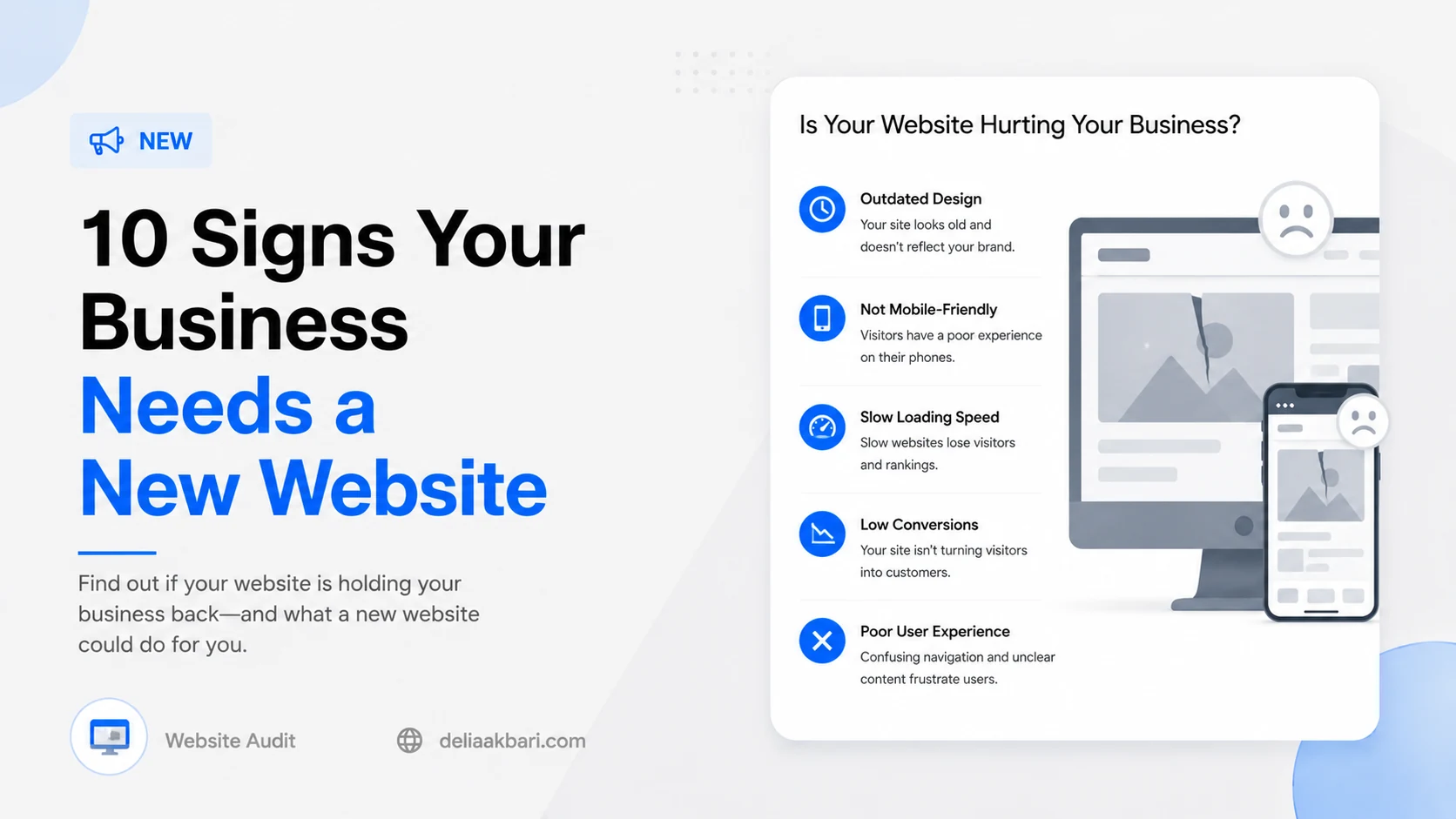
Most business owners keep a website far longer than they should, not because it's working, but because replacing it feels like a hassle. Meanwhile it quietly turns away customers every day. Here are ten signs it's time to stop patching and start fresh. If more than a few sound familiar, your site is costing you more than a new one would.
1. It's slow to load
If your site takes more than three seconds to load, you're losing visitors before they see anything. People are impatient on the web, especially on their phones, and Google treats speed as a ranking factor. Old page builders, oversized images, and plugin bloat are usually to blame, and sometimes the cleanest fix is a lean rebuild rather than endless optimization of a heavy site.
2. It looks bad on a phone
Most of your visitors are on mobile. If they have to pinch and zoom, if text runs off the screen, or if buttons are too small to tap, they leave. A site that was "responsive enough" five years ago often isn't anymore. If your site doesn't feel effortless on a phone, that's a serious problem, not a cosmetic one.
3. It looks dated
Design trends move, and a site that looked current in 2018 can quietly signal "behind the times" today. First impressions form in seconds, and a dated site makes even an excellent business look less trustworthy and less established than its competitors. Fair or not, people judge your business by your website.
4. You're embarrassed to send people to it
This is the most honest sign of all. If you hesitate to put your website on a business card, or you'd rather send someone to your Instagram, your site isn't doing its job. Your website should be the place you're proud to point people to, not the one you apologize for.
5. It doesn't bring in any leads or calls
A website is supposed to generate business, not just exist. If yours never produces a call, a form submission, or a booking, something is broken, whether it's unclear messaging, no obvious next step, or the fact that no one can find it in search. A site that doesn't convert visitors into customers is a brochure, not an asset.
6. You can't update it yourself
If changing a phone number or adding a service means emailing a developer and waiting a week (or you've lost access entirely), your site is holding you hostage. A modern site should be straightforward to keep current. When updating feels impossible, the content goes stale, and stale content hurts both customers and rankings.
7. It doesn't show up on Google
If you search your own services and you're nowhere to be found, your site probably wasn't built for search. Thin content, missing structure, no local optimization, and no schema all keep you invisible. Sometimes SEO can be layered onto an existing site; often the underlying structure is the problem and a rebuild is the faster path to ranking. (See the best local SEO tips for LA businesses.)
8. It has no clear call to action
Look at your homepage. Is it obvious what you want a visitor to do next, call, book, request a quote? If someone has to hunt for your phone number or figure out how to contact you, most won't bother. Every page should make the next step obvious. When it doesn't, interested visitors slip away.
9. Your business has outgrown it
Maybe you've added services, changed your focus, moved locations, or leveled up your brand, and your website still reflects the business you were three years ago. When the site no longer matches what you actually do or the clients you now want, it's working against you. Your website should represent where your business is today, not where it started.
10. It's built on something outdated or unsupported
If your site runs on an old platform, an abandoned theme, or a stack no one maintains anymore, you're carrying security risks, broken features, and mounting technical debt. At some point, patching a fragile old site costs more, in money and in missed customers, than replacing it with something clean and built to last.
One or two of these might be worth fixing in place. Four or more, especially slow speed, poor mobile, no leads, and invisible on Google together, almost always mean a rebuild is the better investment. Patching a fundamentally weak site tends to cost more over time than starting clean.
A good website is one of the hardest-working assets a business owns: it earns trust, gets found, and turns visitors into customers around the clock. If yours isn't doing that, it's not a sunk cost you're stuck with, it's an upgrade waiting to pay for itself. Here's what a good small business website actually looks like.