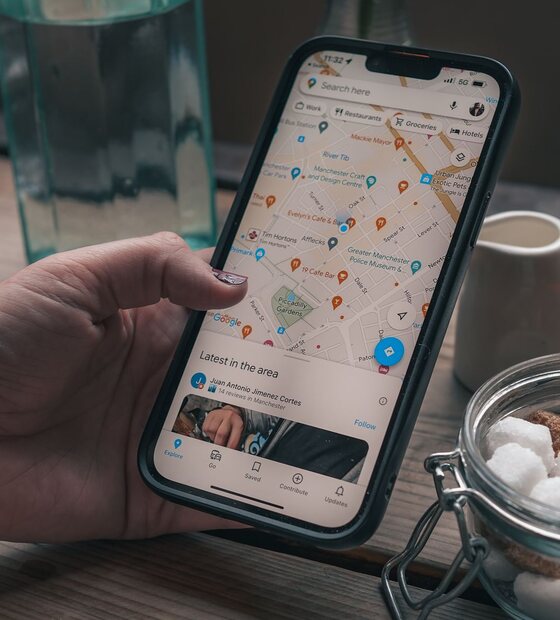
When someone searches "locksmith near me" or "salon in Montrose," the first thing they see isn't a list of blue links — it's a map with three pinned businesses. That's the local pack, and it captures the majority of clicks on searches like these. Landing in it is one of the highest-leverage things a local business can do.
Google doesn't publish its exact algorithm, but it's been consistent for years about the three things local ranking comes down to.
The three pillars: relevance, distance, prominence
- Relevance — how well your profile and website match what someone searched for. Accurate categories, complete service listings, and content that actually describes what you do all feed this.
- Distance — how far your business is from the searcher (or the location they searched). You can't move your shop, but you can make sure your address and service areas are set correctly so Google understands where you actually operate.
- Prominence — how well-known and well-reviewed your business is, both on Google and across the web. This is the pillar with the most room to improve, and where most of the work below is aimed.
With that framework in mind, here's what to actually do about it.
1. Start with a fully optimized Google Business Profile
This is consistently ranked as the single biggest lever in local search — more than backlinks, more than your website. If you haven't already, work through the full profile checklist first: categories, services, photos, posts, and reviews all feed directly into how Google ranks you locally.
2. Build consistent citations across directories
A "citation" is any place your business name, address and phone number appear online — Yelp, Facebook, industry-specific directories, the Chamber of Commerce. Claim the ones relevant to your industry and city, and make sure your information matches exactly everywhere. Inconsistent citations are one of the most common, and most fixable, ranking problems.
3. Earn reviews consistently, not just once
A burst of five reviews when you launch, followed by silence, doesn't carry the same weight as two or three new reviews every week, indefinitely. Recency matters. Build asking for a review into your actual workflow — after every job, every appointment, every sale — rather than treating it as a one-time push.
4. Get local backlinks
Not all backlinks are equal for local ranking — a link from a local news site, a chamber of commerce directory, or a business you sponsor or partner with carries more local relevance than a generic high-authority link from somewhere unrelated. Sponsor a local event, join your chamber of commerce, or ask complementary local businesses to trade mentions.
5. Optimize your website for local search
Your website still matters — it's part of relevance and prominence both. A few specifics:
- Include your city and neighborhood naturally in page titles, headings and body copy
- Add
LocalBusinessschema markup so Google can read your name, address, hours and service area directly from the code - Put your NAP in the footer of every page, matching your Google profile exactly
- If you serve multiple areas, build a dedicated page for each rather than one generic "service areas" list
This is exactly what I set up as part of every website build — local SEO isn't an add-on, it's baked into the site from the start.
6. Publish content that's actually local
Generic, could-be-anywhere content doesn't help you rank for local searches. A short post about a project you completed in a specific neighborhood, or an FAQ that answers a question customers in your area actually ask, does more for local relevance than a vague "About Us" paragraph ever will.
7. Watch engagement, not just position
Calls, direction requests and website clicks from your Google profile are all signals Google can see — and a profile people actually interact with tends to hold its position better than one that just sits there. Check these numbers in your profile dashboard periodically; a sudden drop is often the first sign something (a wrong phone number, an old address) needs fixing.
How long does it take?
Local ranking is a slower burn than most people expect. Profile fixes and citation cleanup can show movement within a few weeks; review volume and backlinks tend to compound over two to six months. There's no shortcut that skips the timeline — but consistency beats intensity here. A little, done every week, outperforms a big push done once.
If your site isn't set up to support any of this — no schema, no local content, inconsistent NAP — that's usually the first thing worth fixing before spending more on ads or marketing.