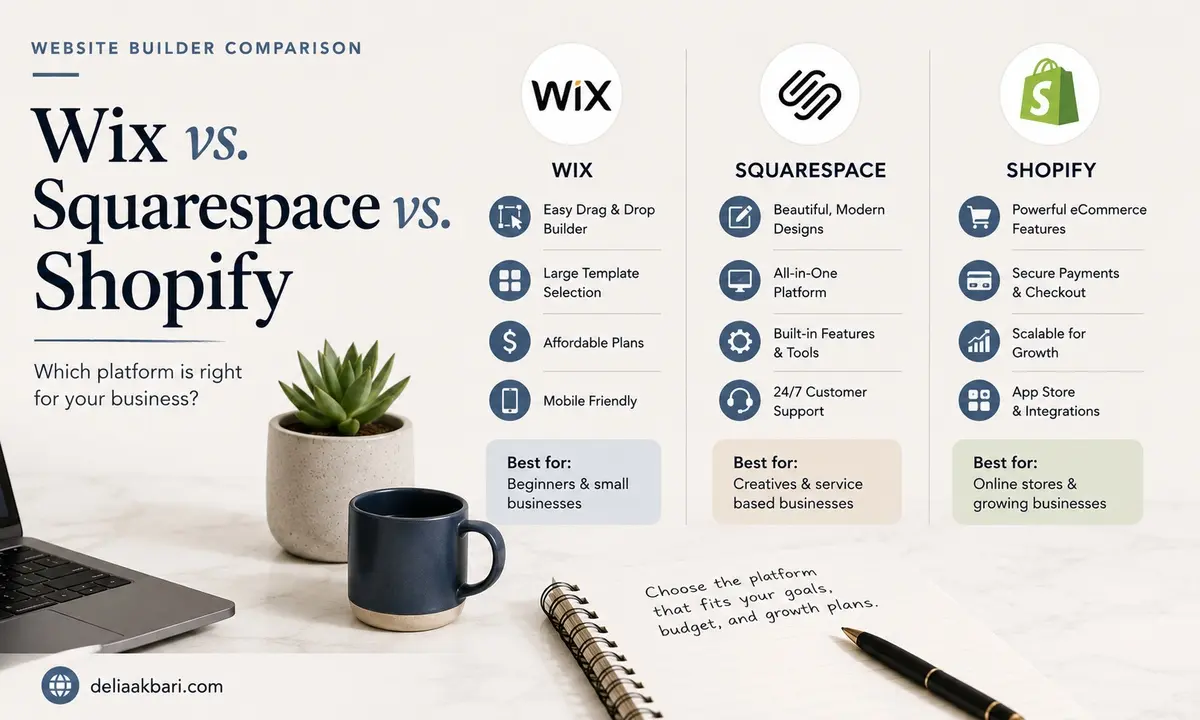
Before comparing features, ask one question: are you selling physical products, or are you running a service business, portfolio, or local shop that mostly needs people to call, book, or visit? That single answer eliminates one of these three immediately, and most comparison articles skip right past it. Here's an honest breakdown of what each platform actually costs and does well in 2026, and where all three of them stop being enough.
The Short Answer
- Selling products, even a handful: Shopify. It's not close. Everything else on this list treats ecommerce as an add-on, Shopify treats it as the whole point.
- A design-forward brand, portfolio, or studio: Squarespace. The templates are the most polished out of the box, with the least fighting to make something look intentional.
- A flexible, budget-friendly site with room to add bookings or a small store later: Wix. The most features per dollar and the widest app marketplace of the three.
Wix
Wix's paid plans run roughly $17 to $39 a month billed annually for most small business needs, with a $159-a-month Business Elite tier for larger stores. Every plan includes a big library of apps for booking, email marketing, live chat, and more, which is Wix's real strength, there's an add-on for almost anything you'd want to bolt onto a site.
Good for: service businesses that want scheduling, a store, and a blog all in one system without paying for three separate tools.
Watch out for: the sheer number of options can make it easy to end up with a site that feels cluttered or generic if you're not deliberate about design choices. The free plan keeps Wix branding and a Wix subdomain, neither of which belongs on a business you're trying to be taken seriously in.
Squarespace
Squarespace's plans run roughly $16 to $99 a month billed annually, with online store transaction fees dropping to zero on the higher tiers. The templates are genuinely the best-looking out of the box of any builder on this list, which is why photographers, designers, and other visually-driven small businesses tend to land here.
Good for: a business where the visual presentation is doing a lot of the selling, restaurants, studios, boutiques, portfolios.
Watch out for: the polish comes with less flexibility than Wix. Customizing a template beyond its intended layout takes more effort, and the app ecosystem for things like advanced booking or CRM integrations is smaller.
Shopify
Shopify's plans run roughly $29 to $399 a month billed annually, plus card processing fees that shrink as you move up tiers, with a separate Plus tier starting around $2,300 a month for large operations. Nothing else on this list comes close to Shopify's inventory management, shipping integrations, and checkout experience.
Good for: any business actually shipping or fulfilling physical products, even at a small scale.
Watch out for: Shopify is built around a store, not a brand. A service business or local shop using Shopify as a general website usually ends up fighting the platform to make it feel like anything other than a store with a few extra pages bolted on.
If you're not selling physical products, cross Shopify off the list entirely, the monthly cost and transaction fees aren't worth it for features you won't use. Between Wix and Squarespace, it usually comes down to whether you'd rather have more built-in tools (Wix) or a more polished starting point (Squarespace). Neither is wrong. What matters more than the platform is whether you actually finish building the site and keep it updated once the initial motivation wears off.
What All Three Miss for a Local Service Business
Builders are genuinely good at what they're designed for: getting something online fast without hiring anyone. Where they consistently fall short for a local business trying to generate leads is technical SEO, page speed, and code structure are capped by the platform no matter how much effort you put in, templates are shared by thousands of other businesses so yours can end up looking like a dozen others nearby, and the site is only as strategic as the time you personally put into arranging it, there's no one making sure the layout is actually built around how your customers decide to call. Here's a fuller look at when DIY makes sense and when it doesn't.
If you've outgrown a builder, or you're starting to suspect the site itself is the reason leads aren't coming in, a custom build doesn't have to cost what you'd expect. See what a small business website actually costs in 2026, or tell me about your business and I'll give you a straight answer on whether a builder is still the right call for you or whether it's time to move past one.