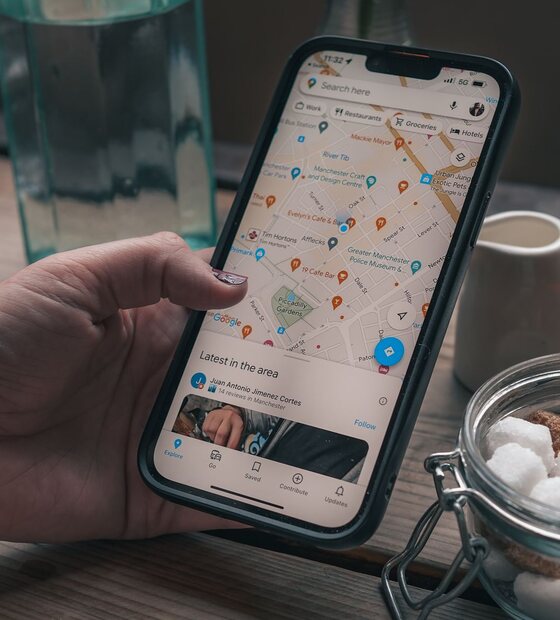
Local search is a different game from regular SEO. When someone types "dentist near me" or "best Thai food in Echo Park," Google isn't just matching keywords. It's trying to answer a real-world question: what business, physically accessible to this person right now, is the best answer for what they're looking for? To do that, it weighs three factors, and understanding them changes how you spend your time.
The local pack: why it matters
Before getting into the factors, it's worth understanding what you're competing for. The local pack is the map with three pinned business listings that appears above the organic results on most local searches. It captures a disproportionate share of clicks on those queries. Being in the top three matters. Being outside it, even at position four or five, is a steep drop-off in visibility.
This is also true on mobile, where the local pack often takes up most of the visible screen before a user even scrolls. For service businesses, restaurants, and retailers, getting into that three-listing box is often worth more than ranking first in organic results.
Factor 1: Relevance
Relevance is about how well your business matches what someone searched for. Google pulls this from multiple places: the primary and secondary categories on your Google Business Profile, the services you've listed, the keywords in your business description, your website content, and even what your reviewers say about you.
This is where specificity pays off. A plumber who lists "Drain Cleaning," "Water Heater Installation," and "Pipe Repair" as individual services has more relevance signals than one who just lists "Plumbing." A category of "Injury Attorney" tells Google more than "Lawyer." Every specific, accurate label you give your business helps Google match you to more specific, purchase-ready searches.
Factor 2: Distance
Distance is how far your business is from the person searching, or from the location they specified in their search. There's not much to optimize here if you have a physical storefront: your address is your address.
However, if you're a service-area business (you go to clients rather than the other way around), your service area settings matter. Make sure your GBP service area reflects where you actually work. Don't set it to all of Los Angeles County if you only serve the Eastside. Accuracy matters more than breadth; an accurate, well-defined service area outperforms an inflated one.
It's also worth knowing that search results vary by the location of the searcher. Someone in Glendale searching for a plumber will see different results than someone searching in Culver City, even if they type the exact same thing. This is why a business can rank well in one neighborhood and not at all in another, and why trying to chase rankings for an entire metro area is usually the wrong frame.
Factor 3: Prominence
Prominence is the most complex factor, and the one with the most room to improve. It reflects how well-known and well-regarded your business is, both on Google and across the web. Think of it as your reputation, measured in data.
Prominence is built from several things working together:
- Review volume and recency. How many reviews you have, and how recently you've been getting them. A business with 80 reviews that all came in two years ago is less prominent than one consistently earning 5 reviews a month.
- Your average star rating. A 4.8 with 30 reviews will typically outperform a 3.9 with 100 reviews for prominence purposes.
- Citations and directory listings. Mentions of your business name, address, and phone number across Yelp, Facebook, industry directories, and local publications all contribute to prominence. Inconsistency across these sources weakens the signal.
- Backlinks to your website. Especially from local, relevant sources like city websites, local news coverage, neighborhood blogs, or the Chamber of Commerce.
- Engagement on your profile. Calls, direction requests, and website clicks generated from your GBP are all signals Google can observe.
Most businesses have more room to improve on prominence than on any other factor. Distance is fixed. Relevance can be dialed in fairly quickly with accurate categorization. But prominence compounds over time, and most competitors aren't actively working on it.
How your website feeds into local ranking
Your website isn't just a separate asset. It's connected to your Google Business Profile and contributes to all three factors. For relevance, your website content should describe your services and your area in plain language. For prominence, a fast, well-structured site that earns backlinks improves your standing. For distance (in a roundabout way), your site should include LocalBusiness schema so Google can confirm your address, hours, and service area without ambiguity.
The basics: include your city and neighborhood in page titles and headings, put your full address in the footer of every page, and make sure the site loads quickly on mobile. These aren't optional if you want local traffic.
What not to do
A few shortcuts that don't work and can actively hurt you:
- Stuffing keywords into your GBP business name. "Joe's Plumbing - Best Plumber Los Angeles CA" violates Google's guidelines and can get your listing suspended.
- Using a fake address. A virtual office or PO box as a storefront address is against policy and won't fool Google for long.
- Buying reviews or using review gating. Google is good at detecting patterns in inauthentic reviews, and the penalties (listing suspension, loss of reviews) cost far more than any short-term gain.
Once you understand how these factors work, most of local SEO becomes systematic rather than mysterious. Work through the local SEO checklist to address each factor methodically. Or, if you want to see what's holding your specific site back, start with the full Google Maps ranking guide for the tactical steps.